Build a proton precession magnetometer
Hello,
I’m rebuilding my old website with WordPress, and when I analyze the 404 errors, I see that hundreds of people would like to look at a former page entitled « Build a proton precession magnetometer ». The main referrer is : https://www.1010.co.uk/org/geophysics.html
So, I copy again the former article because I did not find it on the web, except here :
https://vdocuments.site/build-a-proton-precession-magnetometer.html
and here :
https://fr.scribd.com/doc/148525063/Build-a-Proton-Precession-Magnetometer
« I » in the article is not « me« . So, please don’t contact me to get information about this project. The above article is a copy of an original 1999 article found on aol.com (http://members.aol.com/_ht_a/alka1/ProMag.html)
BUILD A PROTON PRECESSION MAGNETOMETER
An educational « backyard » project, constructed using easily obtained electronic parts. A frequency counter is used to measure the post-polarizing pulse proton precession frequency. The measured frequency is related, by a physical constant, to the magnitude of the local geomagnetic field.
Background
For some background information and a description of a practical application for a proton magnetometer, see « The Amateur Scientist « column in the February 1968 issue of Scientific American. Construction of a dual coil magnetometer is described. Information in that article formed a basis for the details shown here.
I constructed a fluxgate magnetometer several years ago. It was based upon Richard Noble’s article in the September 1991 issue of Electronics World + Wireless World. With a chart recorder, it is possible to see the diurnal changes in the east-west component of the earth’s magnetic field, after nulling out the overpowering total and north-south components.
After finding the February 1968 Scientific American article, I thought that it would be an interesting project to try adding a frequency counter to the proton magnetometer.It would be an interesting « backyard science » project to use it to provide a measure of the earth’s total magnetic field. The addition of a digital to analog converter can provide a output suitable for a chart recorder.
However, a suburban backyard environment is a rather noisy one. Harmonics of the power line frequency extend well up into the audio frequency range. These compete with the decaying precession frequency tone. Connecting the sensor coils in differential series, sensor orientation and instantaneous sampling of the audio signal help in contending with the noise.
From the physical sciences a quantity called the »Larmor frequency » defines the angular momentum of protons precessing in the presence of a magnetic field.
There are currently quantum-mechanical views that explain particle precession, but a classical explanation seems a bit easier to comprehend. A proton, a charged particle, may be thought of as having definite « spin » about an « axis » and acts as a small magnet. An externally applied magnetic field does not alter the spin rate, but causes the particle to wobble at a slower rate about an axis of precession. This axis tends to align with an external magnetic field. However in weak magnetic fields, any alignment tends toward randomness due to thermal effects and other molecular interactions.
The proton reacts to the perturbing effects of an externally applied magnetic force by precessing at a rate in accordance with a precise constant called the gyromagnetic ratio. For protons this quantity is equal to approximately 267.53 x 1E6 radians per second per Tesla or 42.58 mHz per Tesla.
In the northern latitudes of the U.S. the total magnetic field strength is in the order of 50,000 to 55,000 nanoTesla and varies from location to location. Short period variations due to magnetic storms may reach several hundred nanoTesla. Diurnal variations caused by solar induced ionospheric currents are in the order of tens of nanoTesla. Presently, the long term trend of the total field is in the order of minus 90 nanoTesla per year ( steadily decreasing).
The proton precession frequency detected by a suitable sensor in the geomagnetic field of the earth will be at a frequency in the audio range:
Example: 42.58 mHz / Tesla x 52500 x 1E-9 Tesla= 2235 Hz
In my northeast location the frequency readings average about 2275 Hz, corresponding to a total field of about 53,400 nanoTesla. This seems to correlate with published models. This figure also agrees with the value obtained using the fluxgate magnetometer that was calibrated using a Helmholtz coil. The fluxgate sensor was tipped upward from a horizontal position to nearly vertical to obtain the maximum reading of the earth field.
I have noticed a decrease in the frequency readings of one or two Hertz over the past several months that the sensors have been in place in the backyard. This also seems to agree with the magnitude of the predicted long term variation.
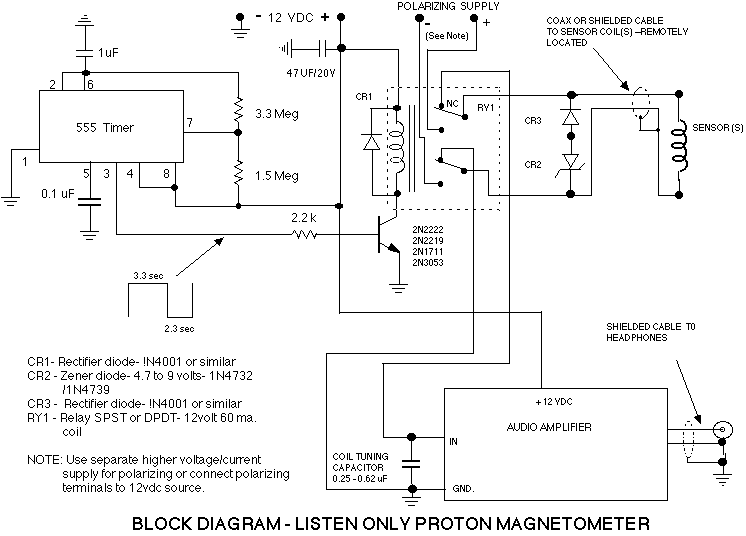
This is a block diagram of a « listen only » version. The frequency counting circuitry is not used. Only the sensor coil(s), audio amplifier and dc power source are included. A timer IC is used to provide switching control to a relay that alternately connects the sensing coil between a polarizing current source and the input to the audio amplifier.(Click figure for larger diagram).
This is a block diagram of a magnetometer design that adds the capability to measure the frequency of the voltage induced in the sensor coil by the precessing protons after the application of a polarizing current several seconds in duration. A four decade BCD counter dis- plays frequency to a selectable resolution of 1 or 0.1 Hz. A frequency multiplier method employs a phase locked loop to provide these resolutions using counter gate intervals much less than one second.

Sensor construction
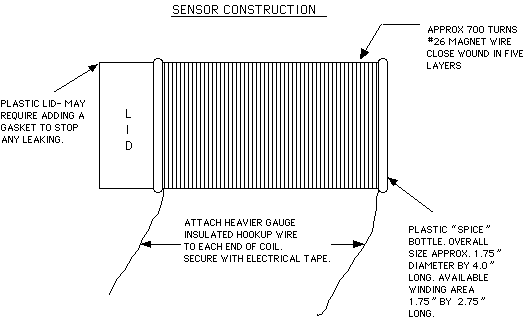
I found the local super market to be a good source for coils forms on which to wind the magnetometer coils and contain the proton medium. Check the area where the spices are located. Particularly look for the store brand spices. I found that these use thin walled plastic containers that have encircling ridges at the bottom and just below the lid. These make a form on which a multilayer coil can be easily wound.
The above referenced page shows the particular size used. There are a number of sizes available. Also found some taller ones that would provide a coil length of about 3.75 inches. A somewhat larger container would conveniently allow the use of a larger wire size. There are advantages —lower coil resistance, providing higher coil Q and possibly higher polarizing current (if the power supply can provide it ). A higher polarizing current increases the initial amplitude of the decay signal.
The higher coil Q will sustain the ringing effect of induced by the decay signal for a longer period of time.Note that the coil inductance increases as function of the square of the number of turns while coil resistance increases as linear function of the number of turns. This suggests that the best results (high Q and tuned circuit selectivity) will be obtained using the largest number of turns and largest wire size that is practical.Also, and possibly most important, the coils will be tuned by the addition of a shunt capacitor—perhaps the most important component of all.
The coil inductance should high enough to permit the use of a reasonably valued non-polarized capacitor. A higher Q will also aid in providing a narrower tuned circuit bandwidth–important in improving the signal to noise ratio and reducing the pickup of high order power line harmonics.
Audio amplifier
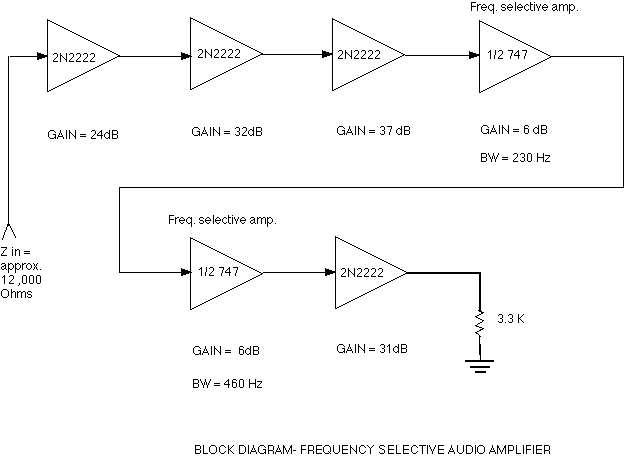
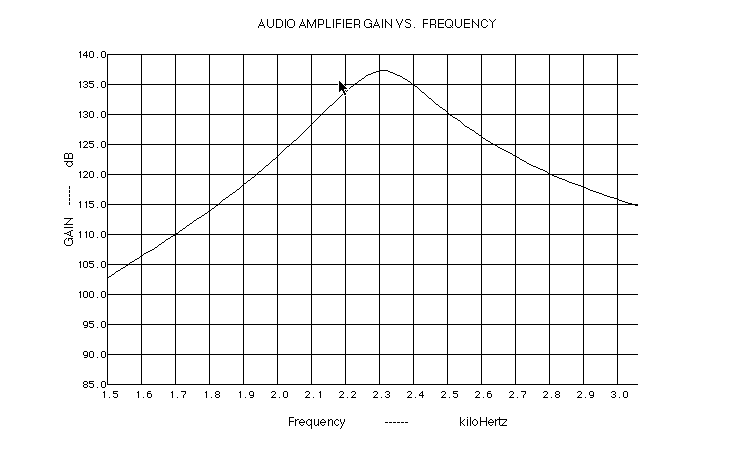
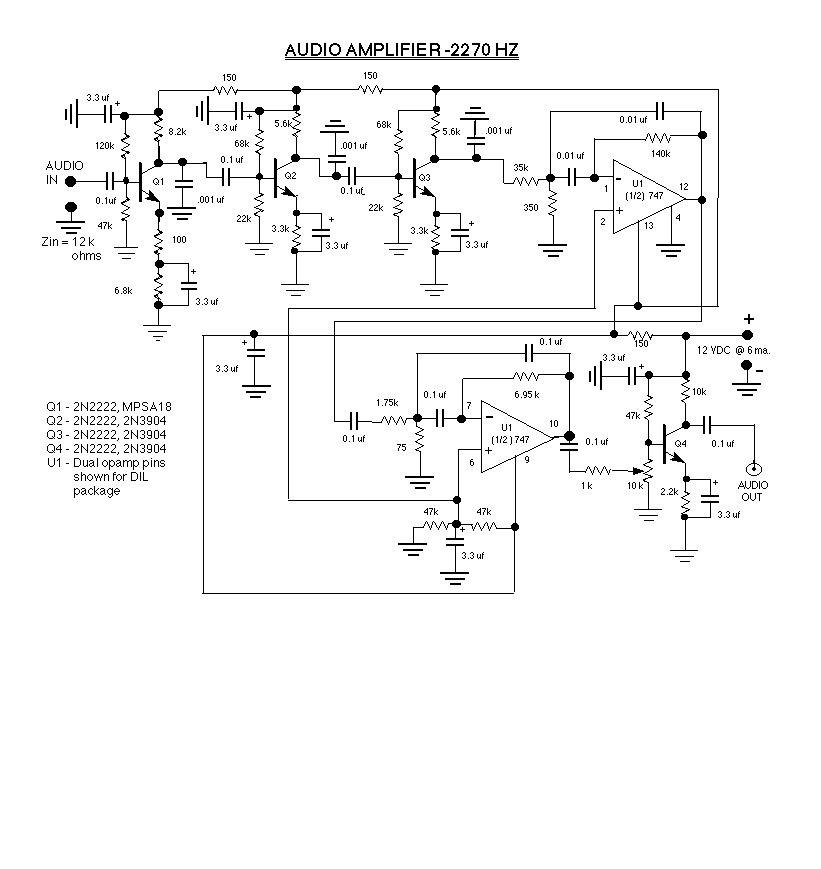
The audio amplifier uses four bipolar transistors and one dual operational amplifier integrated circuit. The block diagram at the left shows the stage gain distribution. The operational amplifier provides a two stage active bandpass filter centered at the expected frequency of the proton precession. Maximum available gain is in excess of 130 dB. The theoretical gain vs. frequency is shown in the figure above. With such high gain careful construction is required to prevent oscillation.
The figure above briefly outlines physical details. The amplifier was built on double sided copper clad PCB material. Components are soldered to standoff terminals. A push-in type nylon or teflon terminal is used. Vectorboard is difficult to use for a circuit made up entirely of discrete components. The circuit board is housed in a Radio Shack molded project case. The inside of the case is lined with adhesive backed aluminum tape.
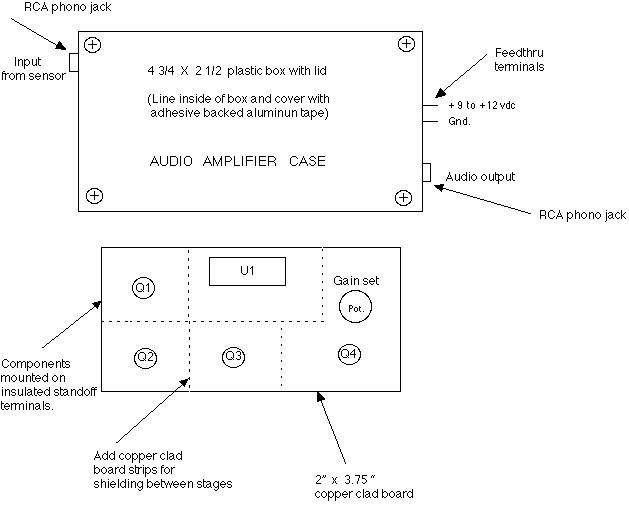
Audio amplifier
The input stage uses a 100 ohm unbypassed emitter resistor to raise the input impedance to about 12 kiloohms to reduce loading on the tuned sensor coils. The tuned circuit formed by the coils and resonating capacitor present a parallel impedance of about 3000 ohms. A number of different devices were randomly selected and tried at the input stage in order to find one providing the best signal to noise ratio. The noise contribution from a 560 ohm resistor soldered across the input terminal can be detected. However, noise from the sensor coils and external pickup exceed the intrinsic amplifier noise contribution.
The following page links to the schematic of a counter implemenation that measures the precession frequency. It was intended as a educational project to attempt to provide a measurement of the magnitude of the local geomagnetic field. It is offered for informational purposes only. Others may find it of interest or may adapt it to a specific practical application. One of my objectives was economy, to use parts that were on hand or easily obtained standard components. For operation from a battery source lower power dissipation equivalent CMOS logic elements can be substituted for the TTL elements shown.
Counter Circuit Description
The circuit shown requires twelve integrated circuits in addition to other discrete components. Integrated circuit choice was based on economy— that is, using parts that were on hand. There are many alternate ICs that may be substituted for the NAND gates, counters and multivibrator. The 4060 counter /oscillator and 4046 Phase Locked Loop IC are probably good choices in any event, but there are other possibilities there also. If power is to be obtained from batteries, substitution of equivalent CMOS logic ICs in place of TTL types will reduce dc current requirements.
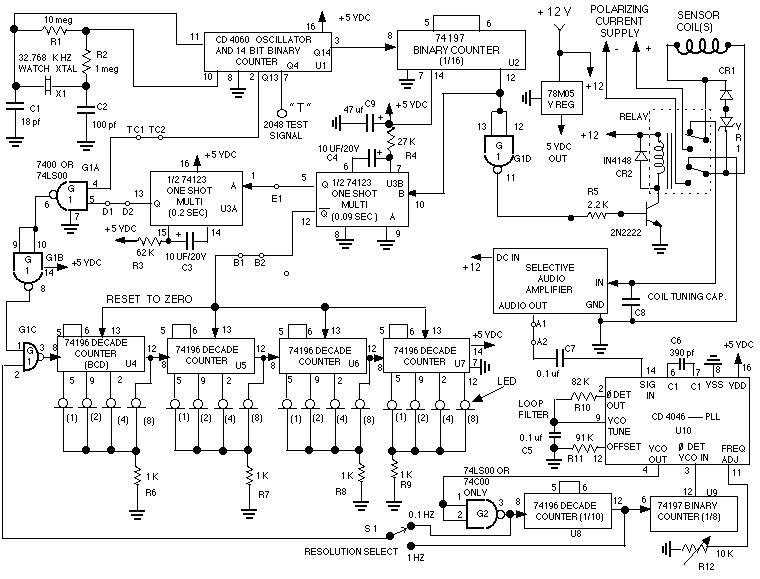
(There is another circuit shown in a separate segment that is a simpler LISTEN ONLY version. It eliminates the frequency counter and uses a timer to cycle the polarizing current to the sensor coils on and off.)
Timing for polarizing the sensors and measuring frequency is derived from a watch crystal. These are the tiny cylindrical units found in some digital wrist watches. They sell for about two for a dollar at Active Electronics or a dollar each at Radio Shack.
The oscillator circuit is pretty much per CD4060/MC14060 application note. The oscillator portion produces an output frequency of 32.768 kHz that is applied to a fourteen stage counter. The final output of the last stage is 2 Hz or a pulse repetition rate of 0.5 seconds. This drives a 4 stage binary counter whose last stage provides a four second high / four second low logic level. For simplicity, the full count cycle of the 4 stage binary counter is used. If the intent is to use the magnetometer in a portable search mode, it would probably be useful to shorten the four second (listen) non polarizing interval to a half second. This will require the addition of at least one four input NAND gate to decode the counter state (10 count ) and reset the counter.
Polarizing current should be applied to the sensing coils for several seconds in order to maximize the amplitude of the precession signal. Three seconds appears to be sufficient. After removal of the polarizing current the the relay connects the coil(s) to the input of an audio amplifier. The output of the audio amplifier is a ringing tone at the precession frequency, whose amplitude rapidly decreases into the background noise level. In order to obtain an accurate measurement of the frequency, the counter should begin sampling immediately after the removal of polarizing current. Also counting should only be done when the signal amplitude is well above the noise level.
Measuring the audio amplifier output directly would require a 1 second counting interval to resolve to 1 Hz at the expected relaxation frequency, and 10 seconds to resolve frequency to 0.1 Hz. Certainly, in the last case, the signal would have long decayed below amplifier noise or local power line harmonics. And, in a backyard environment, after one second, the signal is competing with ac power line harmonics.
A phase locked loop is used to permit measuring the precession frequency to 1 an 0.1 Hz resolutions using counting intervals much less than one second. One input to the phase detector is the output of the audio amplifier. The other input to the phase detector is derived from the voltage controlled oscillator (VCO) whose frequency is divided down by two intervening digital dividers; a divide by 10 and a divide by 8 in series. When in lock the VCO frequency is then equal to the audio amplifier output frequency multiplied by a factor equal to the total division ( 8 x 10 =80). Measuring the VCO output frequency at the output of the divide by ten counter using a counting interval of one-eighth second allows resolution to 1 HZ. Measuring the VCO frequency directly ( ahead of the divide by ten counter ) allows resolution to 0.1 Hz. In this case, the most significant digit (thousands) overflows the fourth stage of the counter leaving the display of hundreds, tens , ones and tenths Hz.
For simplicity and economy, individual light emitting diodes are used to display the state of the decade counter. The schematic shows four LEDs at the most significant digit, two or three should be sufficient since this stage will normally always read the BCD equivalent of a 2 ( two thousand or two hundred depending upon the resolution selected). Under stable conditions, there is only a variation in the least significant digit when using one Hertz resolution or the last two significant digits when resolving to one-tenth Hz. If the intended use is for portable searching, I suspect that it would be desirable to use a decimal display so that changes in the reading may be easily seen. (Although just listening to the audio output may be sufficient to detect magnetic anomalies). There are many choices to implement this composite LCD display, seven segment LCD, etc. These will require the addition of the appropriate BCD to segment decoder/ drivers or the use of the expensive integrated counter/display ICs.
For economy, minimizing interconnecting wiring and component count , monostable multivibrators (one shots) are used to set the decade frequency counter gating and timing intervals. This is probably easier than decoding the states of the CD4060 and 74197 counters (U1 and U2) that derive the time base from the 32.768 crystal. Straight decoding would require several multiple input NAND gates as well as inverters (since the counters do not provide complementary logic outputs – – – – Q and inverted Q).
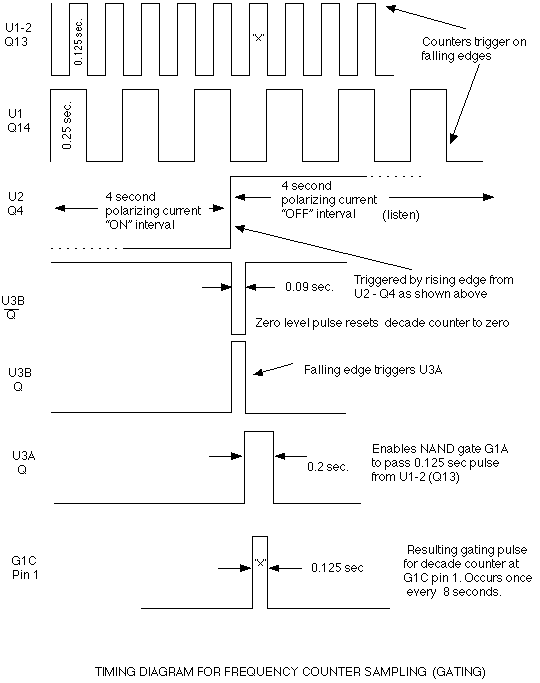
The periods of the multivibrators must be set with some degree of accuracy since the tolerance on the nominal values of the timing components is insufficient to guarantee correct time delays. The existing accurate time base waveforms and the decade counter are used to set the time delays accurately. The timing resistor values, R3 and R4, are varied as needed to provide the correct time delays.
Time Delay Adjustment
The fourth binary stage of the CD4060 oscillator/counter output (Q4) is available at pin 7. The oscillator frequency has been divided by a factor of 16 at this point, resulting in a frequency of 2048 Hz.
U3A Delay
Make the following temporary connections:
1. Open connection between points A1 and A2. Connect A2 to the 2048 test signal at U1 pin 7.
2. Open the connection between points TC1 and TC2. This places an enabling signal to the decade counter input gate that is equal to the time delay of multivibrator U3A.
Adjust the value of R12 at pin 11 of U10 to some value around 8000 ohms or so. This should adjust the free run frequency of the CD4046 VCO to value that will allow it to phase lock to the test signal. At lock the VCO frequency should be 80 times that of the test signal or 163840 Hz. Set the resolution switch (S1) to 1 Hz. This connects the divided (by 10) VCO frequency of 16384 to the decade counter input gate.
Use a nominal value of 56 kohms or 62 kohms as the timing resistor for R3.
The counter display should produce a new reading every eight seconds. The desired counter display should be equivalent to 0.2 seconds which will be displayed as 0.2 X 16384 or 3277. Select a value of resistor to give time delay of 190 to 210 milliseconds or a counter reading between 3112 and 3440.
U3B Delay:
Leave previous test connections as they were. Make the following additional temporary test connections:
1. Open connection between points D1 and D2.
2. Open connection between points B1 and B2. Connect a short insulated wire to B1 such that you can manually touch it to ground to reset the decade counter zero.
3. Temporary connection from point E1 to D1.
Manually reset the counter by manually grounding B1. Observe counter reading as before and reset counter manually as needed. Use an initial value of 27 kohms for R4.
Adjust the value of R4 to provide a delay time between 90 and 100 milliseconds, equivalent to counter readings between 1475 and 1638.
Restore all connections to normal per schematic.
VCO Frequency:
Temporarily connect point A1/A2 to ground. Adjust value of R12 to produce a counter reading of 2230 to 2250. Remove temporary ground.
(Unknown author) Rev 10 Feb 1999
Richard Noble’s article in the September 1991 article of Electronics World + Wireless World
